It started as a spreadsheet.
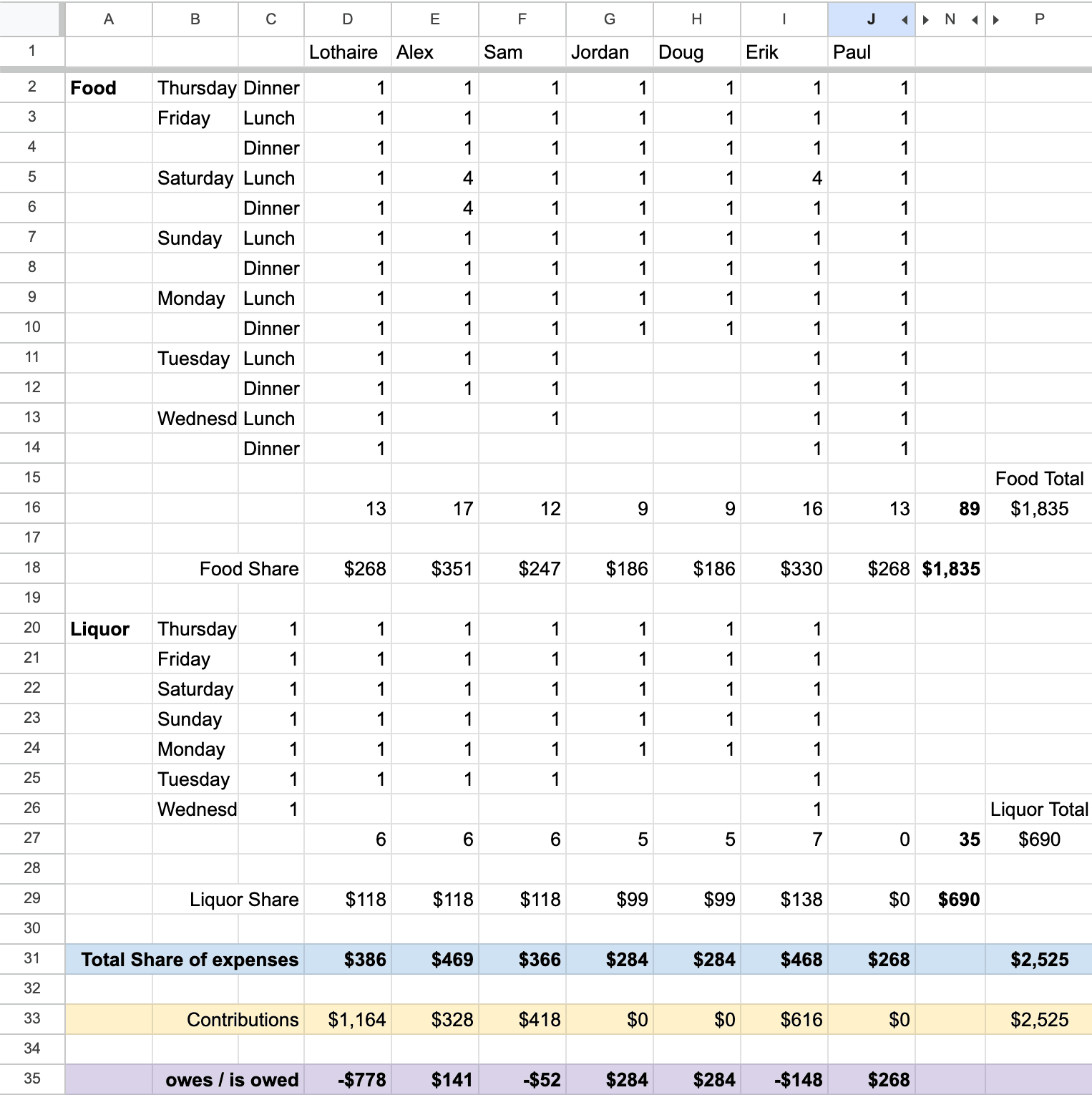
For over a decade, I’ve rented a summer share house in Fire Island Pines, sub-letting rooms to a rotating cast of friends through the season. Every house came with the same kinds of math: housemates arriving and leaving on different dates, couples wanting to settle as one, non-drinkers who’d rather not chip in for the bar, and a stack of Pines Pantry receipts at the end of each week — paid by whoever was cooking dinner that day.
The one I really cared about was the guests. Someone’s friend over for dinner, someone’s partner crashing on the couch for a few nights — I didn’t want rigid rules (“you get three dinner guests a week”), but I also didn’t want the housemates who didn’t invite guests to feel like they were quietly underwriting everyone else’s social calendar. So I built a system of daily weights: each housemate’s share went up a little for each guest-night they brought into the house, and the totals redistributed accordingly.
The spreadsheet got the answer right. Then it got long. And brittle. And every new house got a fresh copy with one more weird edge case bolted on — until the only person who could actually maintain it was me.

Then it became an app.
I’m a software engineer by day, and I’d been looking for a side project — something with a real problem, a real user base (me and my housemates), and an excuse to learn a new framework. Turning the spreadsheet into a Flutter app fit the brief.
Around the same time, I tried Splitwise on a friend trip and was dismayed at how little of the math I cared about it could actually handle. Between a spreadsheet only I could maintain and a paid app that couldn’t do what I wanted, the project picked itself — I’d build the expense tracker I actually wanted to use.
The first year was nights and weekends, learning Flutter while building the thing. The pace picked up over the last eight months once I worked AI coding tools into the loop, and the app finally went live on iOS, Android, and the web.
Tabello is free. The math, the trackers, the share-by-link onboarding, the receipt scanning — all of it. The only paid feature is bank sync (Plaid), and that’s because Plaid charges per connected account and I can’t absorb that cost as the user base grows. There’s no VC behind this, no growth team, no upsell roadmap. It costs what it costs to run, and I’d like to keep it that way.
Where it is now.
I ended up spending a lot of time on this — mostly because I tried to apply the same rigor and design principles I use at my day job. My friends and I have been using it for a while now: it’s replaced the summer-house spreadsheet, and it’s quietly become useful for things I didn’t build it for — most recently a group buy of opera, dance, and concert tickets for next year’s season.
If you’ve poked around and something worked surprisingly well — or didn’t work at all — drop me a note, the support page goes straight to me.
— Lothaire