How to Split a Vacation Rental When People Stay Different Nights
One friend is stuck at work until Friday night. Another has to leave Monday morning. Splitting the house four ways stops being fair the moment the schedules stop matching.
Updated July 18, 2026
Four friends rent a beach house, Thursday to Thursday. The booking is $3,600. Splitting it four ways is $900 each, and for about ten seconds that feels like the obvious answer.
Then real life shows up. Two of them drive out Thursday afternoon and take the whole week. Casey gets held up at work and doesn’t make it until Friday night. Devon has to be back for a Monday meeting and leaves at dawn.
Now $900 each means Devon — who slept there four nights — pays exactly as much as the two people who slept there seven. Everyone can feel it, even if nobody wants to be the one to bring it up.
This is the most common unfair split in group travel, and it has a clean fix.
Why an even split stops being fair
A vacation rental is a fixed cost bought by the night. You are not paying for four people; you are paying for seven nights of a house. When someone uses four of those nights and someone else uses seven, an even split quietly transfers money from the short stayers to the long stayers.
It isn’t a fringe concern, either. Anyone who’s watched a group chat go quiet when the spreadsheet comes out knows the tension is real. What’s usually missing is just a method that doesn’t need a spreadsheet or an argument.
Whether the rental itself should be pro-rated is a separate and genuinely contested question — we’ll come back to it once the method is on the table.
The method: person-nights
The fix is to stop counting people and start counting person-nights.
One person staying one night is one person-night. Add up everyone’s nights, and you get the total person-nights the house actually delivered. Divide the cost by that number and you have a per-night rate that you can charge each person for exactly the nights they used.
Three steps:
- Build a schedule covering the rental period, and mark who was present on each night.
- Total each person’s nights, then total everyone’s together.
- Divide the cost by the total to get a per-night rate, and multiply it by each person’s nights.
The shares always add back up to the full amount. Nobody subsidizes anybody, and nothing is left over.
Step 1 — Build the schedule
Lay the trip out night by night and mark who was there. A Thursday-to-Thursday booking is seven nights — you sleep there Thursday through Wednesday and check out Thursday morning:
| Who | Thu | Fri | Sat | Sun | Mon | Tue | Wed | Nights |
|---|---|---|---|---|---|---|---|---|
| Alex | 100% | 100% | 100% | 100% | 100% | 100% | 100% | 7 |
| Blair | 100% | 100% | 100% | 100% | 100% | 100% | 100% | 7 |
| Casey | — | 100% | 100% | 100% | 100% | 100% | 100% | 6 |
| Devon | 100% | 100% | 100% | 100% | — | — | — | 4 |
Alex and Blair take all seven nights. Casey misses Thursday and picks up six. Devon sleeps Thursday through Sunday and leaves Monday morning, so they get four.
Total: 7 + 7 + 6 + 4 = 24 person-nights.
Step 2 — Do the math
Divide the booking by the total person-nights:
The per-night rate
$3,600 ÷ 24 person-nights = $150 per person per night
Then multiply by each person’s nights:
| Who | Nights | Pro-rated | Even split | Difference |
|---|---|---|---|---|
| Alex | 7 | $1,050.00 | $900.00 | +$150.00 |
| Blair | 7 | $1,050.00 | $900.00 | +$150.00 |
| Casey | 6 | $900.00 | $900.00 | — |
| Devon | 4 | $600.00 | $900.00 | −$300.00 |
| Total | 24 | $3,600.00 | $3,600.00 | — |
Devon pays $300 less than an even split would have charged, and that money doesn’t vanish — it’s picked up by the two people who used the house longest. The column totals match, which is the check that tells you the method is sound.
Casey is the interesting row. Six of the twenty-four person-nights is exactly a quarter of the total, so they land on $900 — precisely what the even split would have charged. Missing one night out of seven didn’t earn them a discount, because everyone else’s shortfalls moved the rate too. That’s worth pointing out to anyone who assumes pro-rating is a way of penalising people: it isn’t a judgment about who deserves what, it just tracks usage, and sometimes it tracks straight back to the even split.
Notice also that nobody had to negotiate. The schedule is a matter of fact, and once it’s written down the numbers follow from it. That’s the real benefit: it takes the awkward conversation and turns it into arithmetic.
Decide what gets pro-rated
Should the rental itself be pro-rated, or only the food and supplies? This is the part that causes more friction than the arithmetic ever does, and it’s worth answering deliberately.
Person-nights is a tool, and the group still has to decide what to point it at. Shared trips have two different kinds of cost, and they don’t have to follow the same rule:
- The rental — a single fixed sum, agreed up front, that didn’t change based on who actually turned up.
- Consumables — groceries, gas, firewood, beach parking. Bought along the way, consumed by whoever was around at the time.
Almost nobody argues about the second category. If you weren’t there on Tuesday, you didn’t eat Tuesday’s dinner, and pro-rating consumables is close to universally accepted.
The rental is where reasonable people disagree.
The case for pro-rating the rental
You’re paying for nights of a house. Devon used four of seven nights and got four sevenths of the thing being bought. Charging them for seven is charging them for something they didn’t receive — and if the house had been booked for the days people could actually make, it would have cost less.
The case for splitting the rental evenly
The group decided together to take that house for that week. The booking was sized for four people, and it cost exactly $3,600 whether Devon left on Monday or Thursday. Nobody’s early departure made the house cheaper, so why should it make their share cheaper?
On this view the rental is a shared commitment, not a metered service. You bought the option to be there all week. Whether work, flights, or a Monday meeting stopped you from using all of it is your business, not a discount the rest of the group underwrites.
Pick one before you book
Both are defensible. The failure mode isn’t choosing wrong — it’s not choosing at all, and discovering the disagreement after someone has already changed their flights.
The conversation to have
Before anyone pays a deposit: "Are we splitting the house evenly, or by nights stayed?" Two minutes in a group chat, months before it becomes a real number. Either answer works. Silence is what causes the argument.
A common middle ground: split the rental evenly, pro-rate everything else. People who commit to the trip carry the booking together, and nobody pays for meals they weren’t at. In practice this is the setup a lot of groups land on once they’ve talked it through.
But what about the groceries?
Whichever rule you picked for the rental, the consumables still need handling — and they’re less straightforward than they look, because they arrive as a stream rather than a single number.
The honest answer is that you have two options, and the simple one is usually right.
Option one — split consumables by the same overall ratio. Total up everything spent across the week and divide it by the same person-night shares. This is an approximation, but a good one: if spending is reasonably steady across the trip, Devon — there for four of the seven nights — consumed roughly four sevenths of what a full-week guest did. It’s also enormously less work than the alternative, and it stays fair in both directions, because the long stayers cover more.
Where it breaks down is lumpy spending. If someone does a $400 Costco run on Tuesday for a big final dinner, splitting that by the whole trip’s ratio charges Devon for food they never saw — they’d been home for two days.
Option two — pull the lumpy purchases out. When a single expense clearly benefits a specific group, enter it as its own line split evenly among just those people. Most of the trip runs on the shared ratio, and the one or two obvious exceptions get handled directly.
A practical rule: use the overall ratio by default, and only carve out an expense when it’s both large and clearly attributable to a subset. Two or three carve-outs a week is normal. If you find yourself carving out everything, the group probably wants separate trackers rather than a fairer formula.
Why most splitting apps make this painful
The math isn’t hard, and most apps can technically get there. The problem is that none of them have anywhere to put a schedule, so you end up maintaining the ratios by hand.
Splitting apps are generally built around a list of people and a list of expenses. There’s no concept of when someone was present, so the only levers available are an even split or manually typed percentages — which means recomputing every percentage by hand the moment someone changes their travel plans.
Search for advice on this and one of the more useful results is still a Splitwise blog post from 2011. It’s a good post. It’s also fifteen years old, and the state of the art has not moved much since — most groups are still doing this in a spreadsheet.
A spreadsheet genuinely works, to be clear. Build a grid of people against nights, sum the columns, divide. The catch is maintenance: every schedule change means redoing the ratios, and every new expense means applying them again.
How Tabello handles it
Tabello is a free expense splitter with presence schedules built in. You set the trip’s start and end dates, enter each person’s dates once, and every shared cost is allocated by the resulting person-night ratio — no percentages to type and no formulas to maintain.
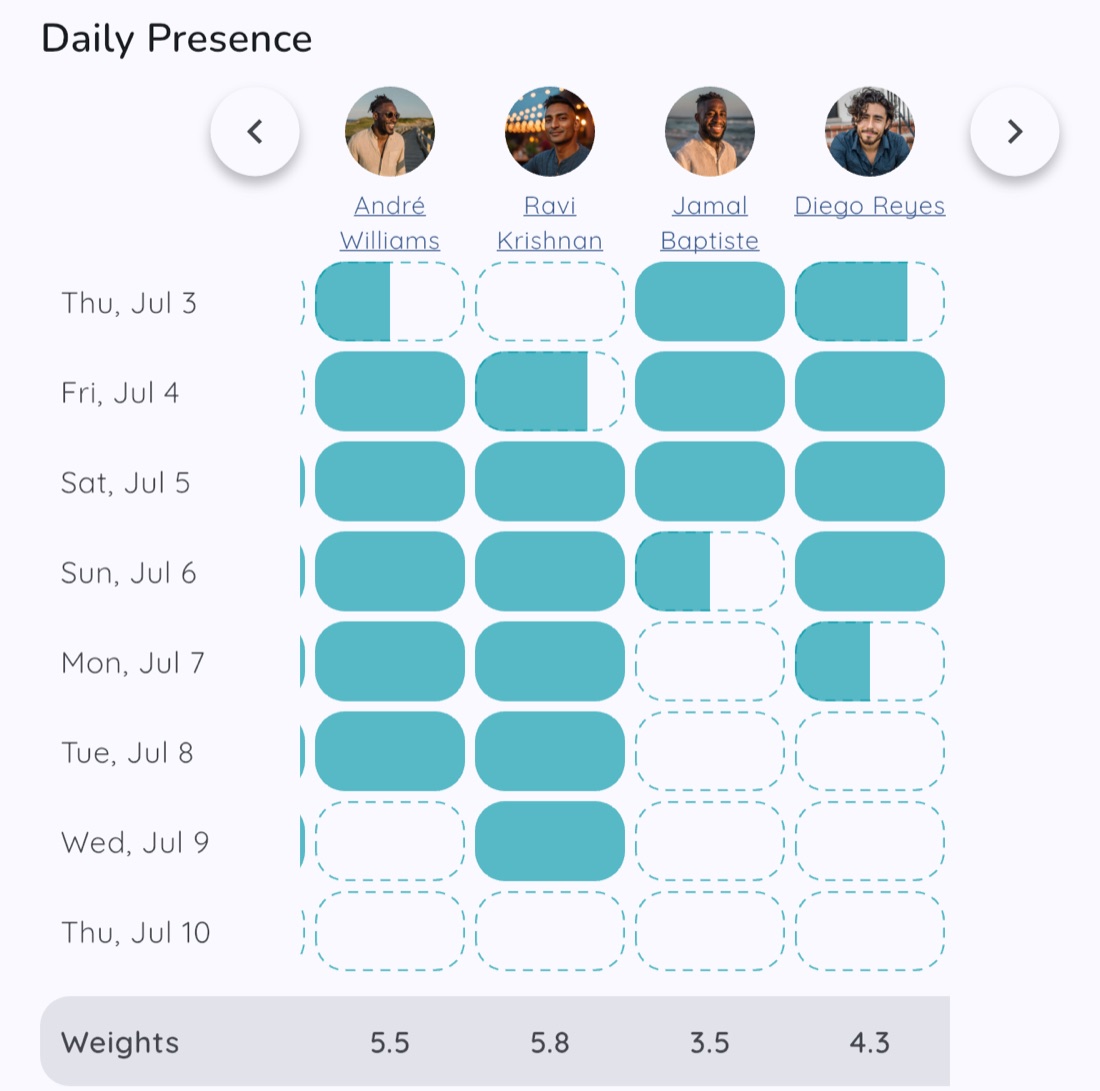
When someone changes their plans, you change their dates and everything recalculates: every expense, every balance, and the final settlement plan. Friends can join from a link in a browser without installing anything or creating an account.
Both of the rules above are covered. Pro-rating everything is the default once the tracker has dates. If the group decided to split the house evenly instead, override the allocation on that one expense to an even split — the booking divides equally, and the groceries, gas, and everything else keep pro-rating by presence. It’s the same override you’d use to carve out a lumpy purchase, applied to the rental instead.
There’s no cap on expenses and no paid tier — the app is free.
Going further: half days and visitors
Once presence is a number rather than a yes-or-no, a couple of common situations get easier.
Partial days
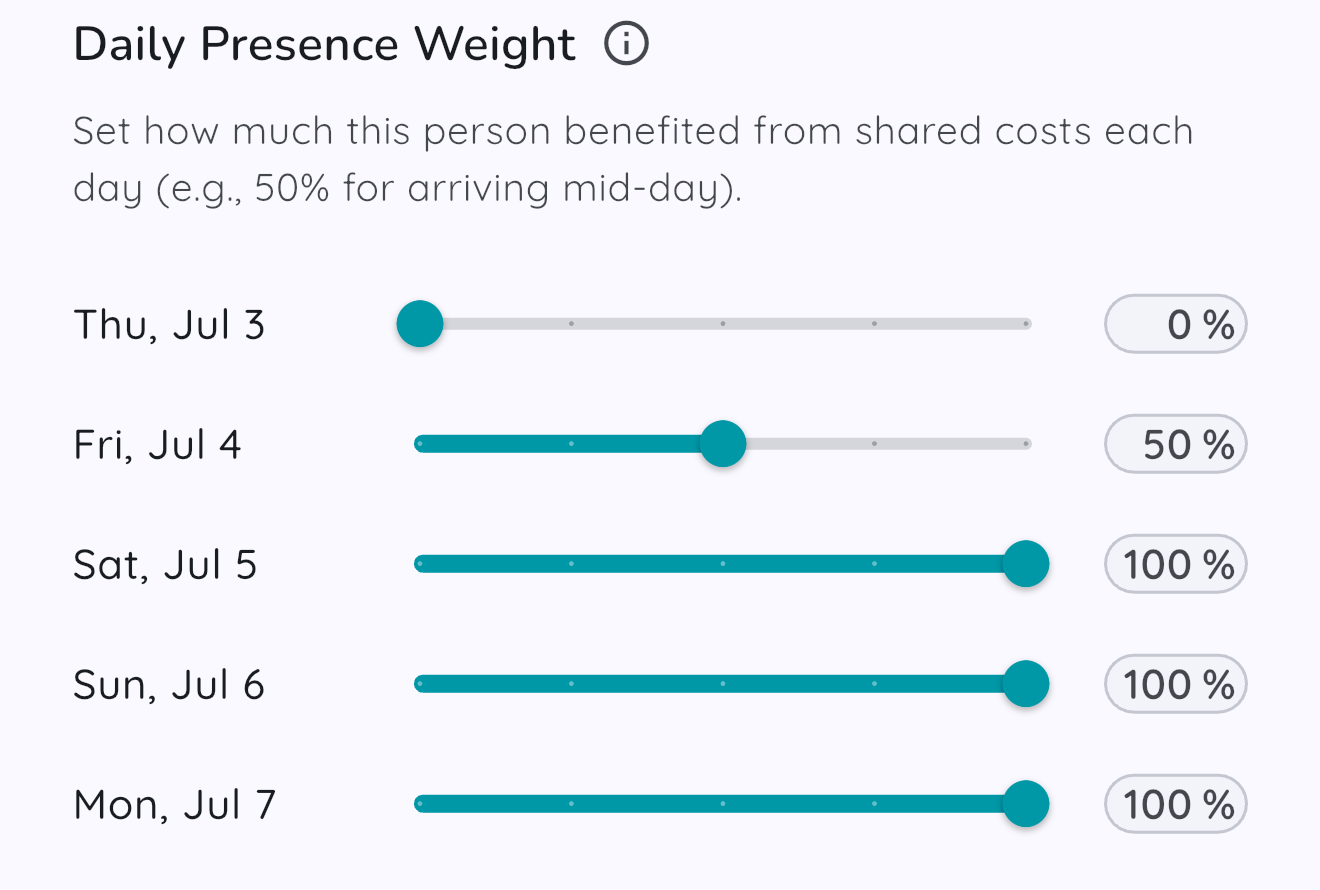
Presence doesn’t have to be all or nothing. Casey rolling in at 10pm on Friday didn’t get the same use out of Friday as someone who woke up there, so record that night at 50% instead of 100%. Casey’s six nights become 5.5, the total becomes 23.5, and every share adjusts — including everyone else’s, slightly upward.
The same applies in reverse to the person who sleeps at their own place nearby but spends every day at the house: full days, half weight, all week.
Day visitors
Someone drives out for Saturday dinner. They’re not on the booking and they didn’t sleep over, but they did eat.
Add them to the schedule as a participant with presence only on the days they were around. Everything else stays at zero, so they pick up a share of the week’s shared costs proportional to the single day they were actually there — and everyone else’s share drops slightly to match.
For visits shorter than a day, agree on a house convention up front and record it as a fraction. One meal counts as half a day, two meals as a full day is a common one, and it works well precisely because it’s decided before anyone’s counting. The point isn’t the specific number; it’s that the group agreed on it in advance rather than negotiating after the fact.
The short version
Count person-nights, not people. Decide up front whether the rental is pro-rated or split evenly — both are fair, but pick one before anyone books. Pro-rate the consumables either way, and pull out any single purchase that's both large and obviously not shared. That's the whole method.